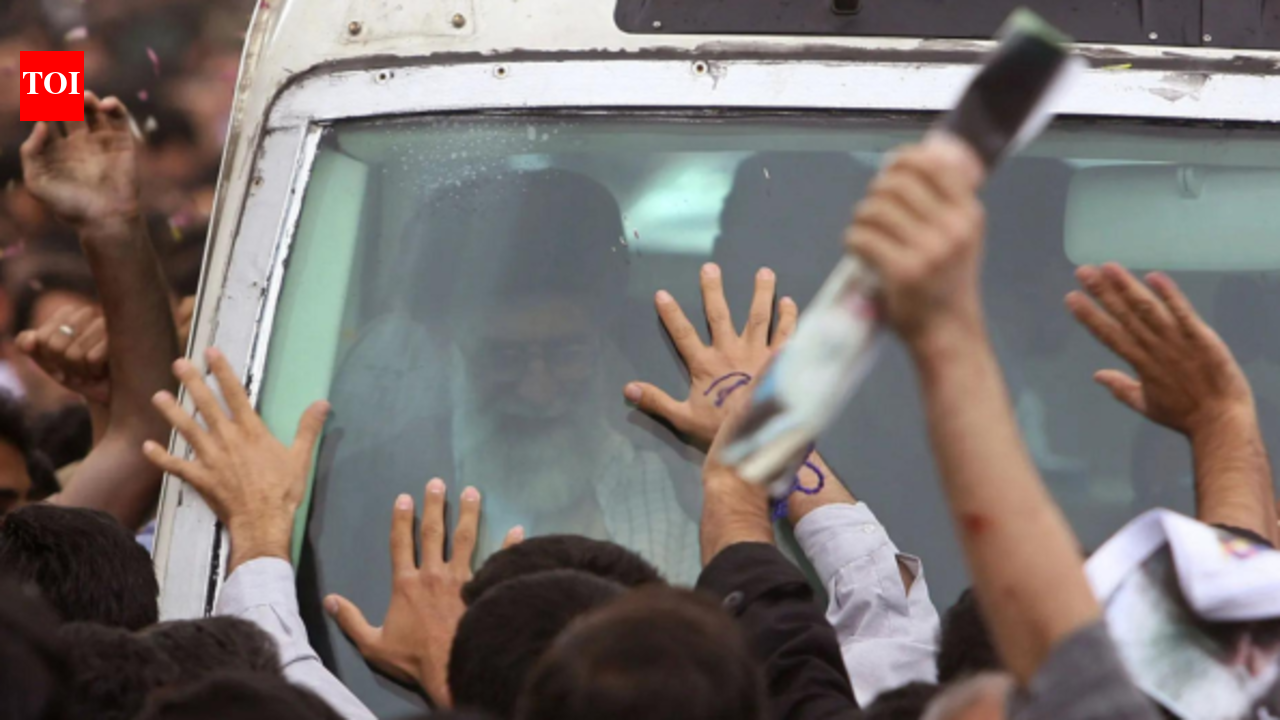
The Escalating Pressure on Iran: Why US and Israel Eye Khamenei's Leadership
Recent escalations in the long-standing geopolitical rivalry between the United States, Israel, and Iran have brought a potent and perilous strategy into sharp focus: the potential targeting of Iran's Supreme Leader, Ayatollah Ali Khamenei. Amid reports of US-Israeli attacks striking sites in Iran, including areas linked to Khamenei's compound and offices in Tehran, the question of "decapitating" the Islamic Republic's leadership has gained chilling prominence. This isn't merely a rhetorical flourish; it reflects a deep-seated strategic calculus by Washington and Jerusalem, driven by decades of adversarial relations, Iran's nuclear program, and its regional influence.
The pursuit of such a high-stakes objective underscores the profound frustration and perceived threat emanating from Iran's current trajectory. Understanding why these two global powers might contemplate such an extreme measure requires a comprehensive look at Khamenei's role, Iran's strategic ambitions, and the delicate balance of power in the Middle East.
The Strategic Calculus Behind Targeting Iran's Supreme Leader
Ayatollah Ali Khamenei, at 86 years old, has been the undisputed Supreme Leader of Iran since 1989, succeeding the charismatic Ayatollah Ruhollah Khomeini, the architect of the 1979 Islamic Revolution. His position is not merely ceremonial; it grants him ultimate authority over all branches of government, the military, and the judiciary, while simultaneously serving as the country's spiritual guide. This unparalleled concentration of power makes him the ultimate decision-maker on all critical matters of state, from domestic policy to Iran's confrontational foreign policy and its controversial nuclear aspirations.
For the US and Israel, the concept of a "decapitation strike" against Khamenei's leadership apparatus is rooted in the belief that removing the head could paralyze the body. The strategic objective behind such a move would be multi-faceted:
- Disruption of Command and Control: Severing the top leadership could create a power vacuum, disorienting Iran's political and military establishments, at least in the short term.
- Policy Reorientation: The hope might be that a successor, or a period of internal struggle, could lead to a less confrontational stance or a shift in policies deemed threatening by the West, particularly concerning the nuclear program and support for regional proxies.
- Sowing Internal Dissent: The absence of the Supreme Leader could exacerbate existing social and economic grievances within Iran, potentially fueling anti-government protests that Khamenei has historically suppressed.
- Symbolic Impact: Such an act would send an unequivocal message, demonstrating the resolve of the US and Israel to counter what they perceive as Iranian aggression.
However, this strategy is fraught with immense risks, as the Iranian system is designed to endure beyond any single individual, even one as powerful as the Supreme Leader.
Khamenei's Unwavering Stance and its Impact on US-Israel Relations
Under Khamenei's three-decades-long rule, Iran has maintained an explicitly adversarial relationship with the West, particularly the United States and Israel. He has famously declared the US as Iran's "number one enemy," with Israel trailing closely behind. This deeply ingrained anti-Western, anti-Zionist ideology isn't just rhetoric; it shapes Iran's foreign policy, its significant investment in regional proxy groups, and its pursuit of missile technology.
Despite intense international sanctions, diplomatic isolation, and several rounds of internal protests over economic hardship and human rights issues, Khamenei has remained steadfast. His resilience has solidified his image as a symbol of Iranian resistance against perceived foreign interference. For Jerusalem, in particular, Iran's stated goal of eliminating Israel, coupled with its nuclear ambitions and the actions of groups like Hezbollah and Hamas, represents an existential threat that they are prepared to confront decisively. Israel's Defence Minister Israel Katz openly stated that "A dictator like Khamenei who stands at the head of a state like Iran and has the horrible goal of destroying Israel – cannot continue to exist." This sentiment reflects a profound conviction that the current Iranian leadership, with Khamenei at its helm, is fundamentally irreconcilable with Israel's security.
The Nuclear Dimension and Escalating Tensions
The core of the recent escalation and the enduring friction revolves around Iran's nuclear program. While Khamenei has consistently maintained that Iran would never build a nuclear weapon and that its program is for civilian purposes only, this narrative is fiercely contested by Israel and segments of the US government. Both US intelligence agencies and the UN nuclear watchdog have, at various points, stated they found no evidence that Iran was actively pursuing an atomic weapon. Nevertheless, Israel and some former US administrations have vehemently pushed a counter-narrative, fueling fears of proliferation.
The derailment of negotiations over Iran's nuclear program further exacerbates these tensions. For Israel, a nuclear-armed Iran is deemed an unacceptable threat, regardless of stated intentions. The belief is that if Iran possesses the capability, it might eventually acquire the weapon. From Jerusalem's perspective, targeting leadership is one potential (albeit extremely risky) pathway to force a radical shift in Tehran's nuclear strategy or to prevent it from ever crossing the threshold to weapons capability. The recent attacks in and around Tehran, some reportedly near Khamenei's significant compounds, serve as a stark reminder of the precision and intent behind these escalating pressures, which often coincide with setbacks in nuclear diplomacy.
The Role of Iran's Security Apparatus in Maintaining Khamenei's Power
Critical to Khamenei's enduring power and the stability of the Islamic Republic is the unwavering loyalty of two of Iran's premier security institutions: the Islamic Revolutionary Guard Corps (IRGC) and the Basij paramilitary forces. The IRGC, a formidable military and economic entity, not only protects the regime internally but also projects Iran's power regionally through its Quds Force. The Basij, with hundreds of thousands of volunteers, serves as an internal security force, fiercely loyal to the Supreme Leader and instrumental in suppressing dissent and enforcing Islamic norms. Their deeply intertwined relationship with the Supreme Leader means that any strategy aimed at "decapitating" the leadership would also implicitly seek to destabilize these formidable institutions. However, their pervasive influence and indoctrination also mean that their loyalty might be difficult to shatter, potentially leading to increased radicalization rather than disarray.
Navigating the Complexities: Risks and Repercussions of a "Decapitation" Strategy
While the motivations for the US and Israel to target Khamenei's leadership are clear from their perspective, the risks associated with such a "decapitation" strategy are immense and potentially catastrophic for regional and global stability. The Middle East is already a powder keg, and any direct military action against the Supreme Leader could unleash an unpredictable cascade of events:
- Regional War and Escalation: Such an act would almost certainly trigger severe retaliation from Iran, potentially engulfing the entire region in a devastating conflict involving its proxies, direct missile strikes, and maritime disruptions.
- Unintended Consequences: Instead of creating a power vacuum, it could lead to the emergence of an even more hardline or vengeful successor, or rally the Iranian population around the flag in defiance of foreign aggression. The Supreme Leader could become a martyr, unifying disparate factions within Iran.
- Internal Instability: While some hope for internal collapse, the outcome could also be prolonged civil strife, leading to a humanitarian crisis and further destabilization.
- International Condemnation: An assassination attempt or strike on a national leader would be widely condemned globally, severely eroding international diplomatic norms and potentially isolating the aggressor nations.
- Cyber Retaliation: Iran possesses significant cyber warfare capabilities and would likely unleash widespread attacks on critical infrastructure.
The explicit threats from Jerusalem, such as Prime Minister Benjamin Netanyahu's suggestion not to rule out an attempt to "end" Khamenei, highlight the extreme tension. However, the practical execution of such a high-stakes operation is fraught with diplomatic, ethical, and logistical challenges. It's crucial to differentiate between strong rhetoric and actionable policy, as the former often serves a deterrent or signaling purpose. The long-term implications for Iran and the wider region of such an action are thoroughly explored in discussions surrounding US-Israel Attacks Target Khamenei in Tehran: What it Means for Iran, where the potential aftermath of these targeted actions is considered. Furthermore, the intensity of Israel's Threats to "End" Khamenei: Escalating Iran Conflict demonstrates the growing sense of urgency and desperation from one of the primary actors in this geopolitical chess game.
Ultimately, while the US and Israel may view Khamenei's removal as a way to fundamentally alter Iran's trajectory, the reality is that the Iranian system is deeply entrenched, and any such action carries immense, unpredictable, and potentially catastrophic risks for stability in the Middle East and beyond.
Conclusion
The US and Israel's interest in potentially "decapitating" Iran's Khamenei leadership stems from a complex interplay of factors: his ultimate authority, his unwavering anti-Western stance, Iran's nuclear program, and its destabilizing regional activities. From the vantage point of Washington and Jerusalem, removing the Supreme Leader represents a drastic, high-risk strategy to neutralize a perceived existential threat and compel a fundamental shift in Tehran's policies. However, the historical resilience of the Islamic Republic, the deep loyalty of its security apparatus, and the unpredictable nature of Middle Eastern geopolitics mean that any such action would be fraught with immense perils, risking an unprecedented escalation of conflict. The ongoing dynamic between these major players, with Tehran at its epicenter, remains a critical flashpoint, demanding meticulous diplomatic and strategic navigation to avert a wider catastrophe.